This example is taken from the ProBound web server.
This example produces a single CTCF binding model by training on SMiLE-seq data.
import torch

import pyprobound
import pyprobound.plotting
Data specification
alphabet = pyprobound.alphabets.DNA()
dataframe = pyprobound.get_dataframe(
    "http://pbdemo.x3dna.org/files/example_data/"
    "singleTF/countTable.0.CTCF_r3.tsv.gz"
)  # SMiLE-seq count table generated from Isakova et al. (2017)
dataframe.head()
| 1 | 2 | |
|---|---|---|
| 0 | ||
| AAAAAAAGCCCGGAAATAGGCAACTTGTAG | 0 | 1 |
| AAAAAAAGGATGTTCCTAGCAACTTATAAA | 1 | 0 |
| AAAAAACAACGATAACCAACTGCTGCCGGA | 0 | 1 |
| AAAAAACACATGTATGAGTTTTTGATGGAG | 1 | 0 |
| AAAAAACCCTCCTTGGTGTCGGACGGCTAT | 0 | 1 |
count_table = pyprobound.CountTable(
    dataframe,
    alphabet,
    left_flank="ACACTCTTTCCCTACACGACGCTCTTCCGATCTTGACGTC",
    right_flank="GACGTCAGATCGGAAGAGCTCGTATGCCGTCTTCTGCTTG",
    left_flank_length=5,
    right_flank_length=5,
)
Model specification
PSAMs
nonspecific = pyprobound.layers.NonSpecific(alphabet=alphabet, name="NS")
psam_1 = pyprobound.layers.PSAM(
    kernel_size=12,
    alphabet=alphabet,
    max_kernel_size=18,
    increment_flank=True,
    shift_footprint_heuristic=True,
    increment_footprint=True,
    increment_flank_with_footprint=True,
)
psam_2 = pyprobound.layers.PSAM(
    kernel_size=12,
    alphabet=alphabet,
    max_kernel_size=18,
    increment_flank=True,
    shift_footprint_heuristic=True,
    increment_footprint=True,
    increment_flank_with_footprint=True,
)
psams = [psam_1, psam_2]
Modes
modes = [
    pyprobound.Mode.from_nonspecific(nonspecific, count_table),
    pyprobound.Mode.from_psam(psam_1, count_table),
    pyprobound.Mode.from_psam(psam_2, count_table),
]
Rounds
round_0 = pyprobound.rounds.InitialRound()
round_1 = pyprobound.rounds.BoundUnsaturatedRound.from_binding(modes, round_0)
Experiment
experiment = pyprobound.Experiment(
    [round_0, round_1],
    name="CTCF",
    counts_per_round=count_table.counts_per_round,
)
Model
model = pyprobound.MultiExperimentLoss([experiment], pseudocount=20)
Fitting
optimizer = pyprobound.Optimizer(
    model,
    [count_table],
    greedy_threshold=2e-4,
    device="cpu",
    checkpoint="CTCF.pt",
    output="CTCF.txt",
)
optimizer.train_sequential()
tensor(0.6677)
optimizer.reload()
{'time': 'Tue Apr 23 19:22:06 2024',
 'version': '1.3.1',
 'flank_lengths': ((6, 6),)}
Loss
with torch.inference_mode():
    loss, reg = model([count_table])
    print(loss, reg, loss + reg)
tensor(0.6426) tensor(0.0251) tensor(0.6677)
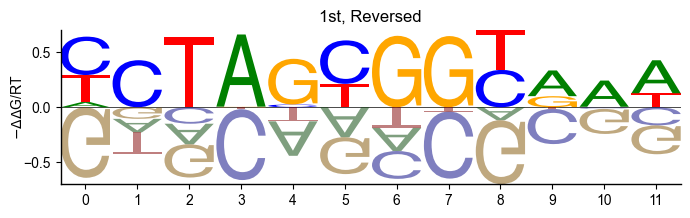
Logo
for psam in psams:
    pyprobound.plotting.logo(psam)
    pyprobound.plotting.logo(psam, reverse=True)
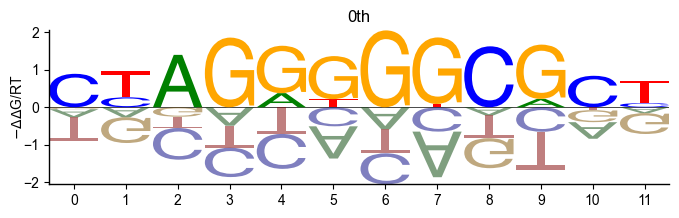
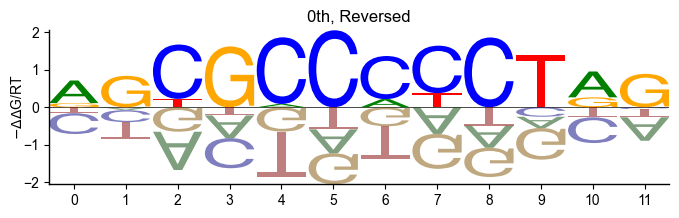
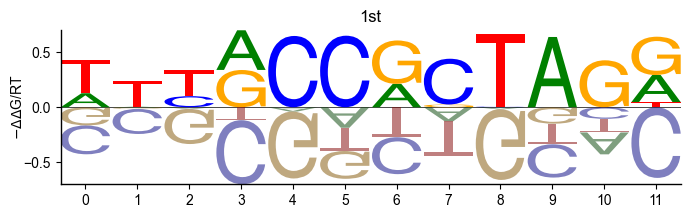
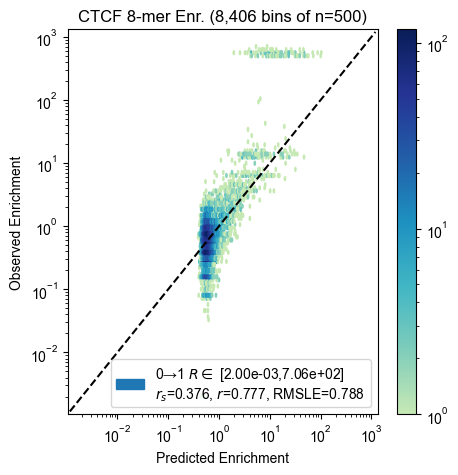
8-mer enrichment
pyprobound.plotting.kmer_enrichment(experiment, count_table, kmer_length=8)
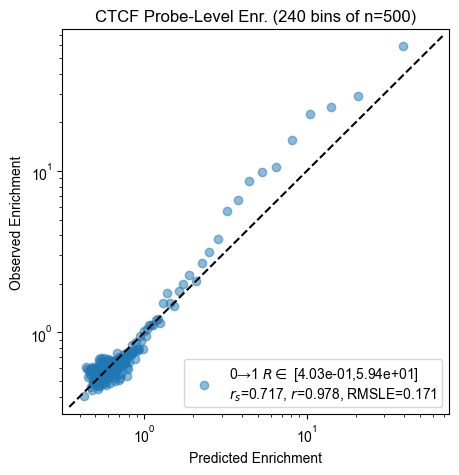
Probe enrichment
pyprobound.plotting.probe_enrichment(experiment, count_table)
Mode contribution
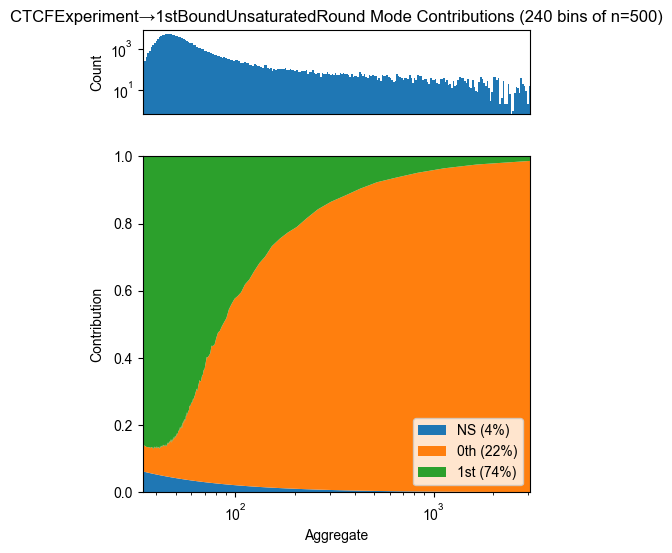
pyprobound.plotting.contribution(round_1, count_table)